ITP Codes of Practice
Professional Standards and Ethical IT Practice
Information technology professionals have responsibilities that go beyond simply making systems work.
IT professionals can influence privacy, security, business operations, public safety and people’s lives.
Professional codes of ethics and practice provide guidance for making responsible decisions and maintaining public trust.
The Institute of IT Professionals New Zealand (ITP) provides professional guidance for IT practitioners, including the Code of Ethics and Code of Practice.
The ITP Code of Ethics
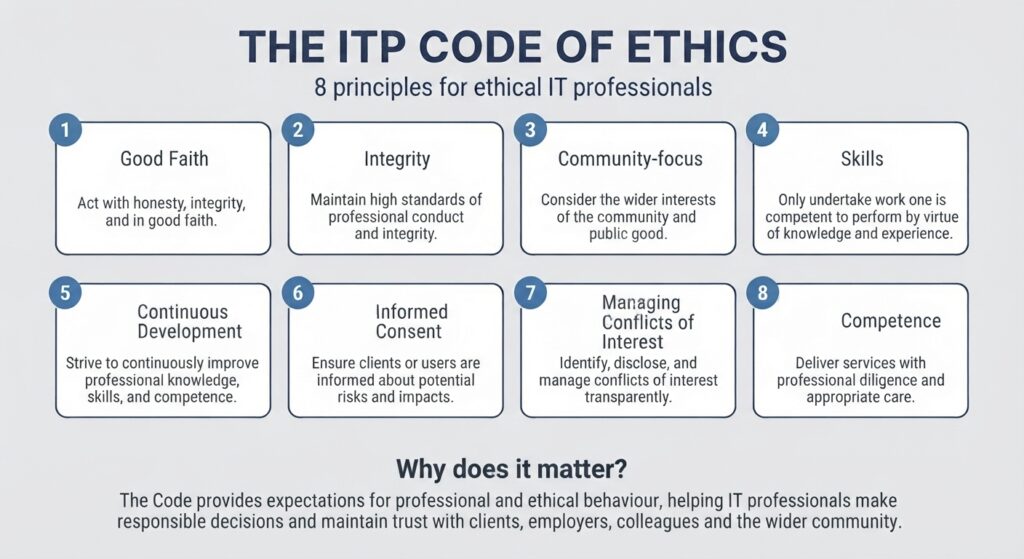
The ITP Code of Ethics identifies eight key principles for IT professionals.
These principles provide a framework for professional and ethical behaviour.
Principle 1 — Good faith
IT professionals should treat people with dignity, good faith and equality.
They should consider the values and cultural sensitivities of the communities affected by their work.
This means professionals should consider how their decisions may affect different individuals and groups rather than focusing only on technical or business requirements.
Principle 2 — Integrity
Professionals should act with honesty, dignity and integrity.
IT professionals need to be trustworthy because organisations and individuals may rely heavily on their technical knowledge and professional judgement.
For example, an IT professional should be honest about the capabilities and limitations of a system rather than making claims that they know are inaccurate.
Principle 3 — Community focus
The welfare and rights of the community should be considered when making professional decisions.
An IT professional should not place private or professional interests ahead of the wellbeing of people affected by their work.
Technology can have consequences beyond the organisation that creates it, so professionals should consider the wider impact of their decisions.
Principle 4 — Skills
Professionals should apply their knowledge and skills in the interests of their clients or employers without compromising their other ethical responsibilities.
IT professionals should use their technical abilities responsibly and consider the consequences of how those skills are applied.
Principle 5 — Continuous development
Technology changes rapidly.
IT professionals should continuously develop their knowledge, skills and expertise throughout their careers.
This can involve:
-
Training
-
Certifications
-
Professional development
-
Research
-
Learning new technologies
-
Keeping up with security threats
Continuous development helps professionals remain capable of working safely and effectively with modern technology.
Principle 6 — Informed consent
Professionals should take reasonable steps to understand and communicate the economic, social, environmental and legal consequences of their actions.
This helps clients, employers and other affected people make informed decisions.
For example, an IT professional should explain important risks and limitations before an organisation commits to a major technology project.
Principle 7 — Managed conflicts of interest
IT professionals should identify and disclose interests that could conflict with their professional responsibilities or affect their impartial judgement.
For example, an IT consultant recommending a particular software product should disclose a relevant financial interest if one exists.
Identifying conflicts of interest helps maintain trust and ensures that professional recommendations are based on appropriate considerations.
Principle 8 — Competence
Professionals should follow recognised professional practice and provide services carefully and diligently within their areas of competence.
An IT professional should not claim expertise that they do not possess.
If a professional does not have the knowledge or skills required for a particular task, they should seek appropriate assistance or additional expertise.
The ITP Code of Practice
The ITP Code of Practice provides guidelines for good and acceptable practice for IT professionals and organisations operating in New Zealand.
The Code of Practice is intended to be considered alongside professional ethical responsibilities.
It covers practical areas of professional conduct, including:
-
Conflicts of interest
-
Professional competence
-
Compliance with regulations
-
Appropriate methods and tools
-
Workload management
-
Client interests
-
Organisational practices
-
Professional participation
-
Representation of the IT profession
The Code of Practice helps translate professional expectations into practical behaviour within the IT industry.
Why do codes of practice matter?
Technology can have significant consequences.
A poorly designed IT system could expose personal information.
Poor security decisions could allow attackers to access sensitive systems.
An inaccurate algorithm could affect people’s opportunities or influence important decisions.
Professional codes help IT practitioners think beyond whether something simply “works”.
A responsible IT professional should consider:
-
Is it legal?
-
Is it ethical?
-
Is it secure?
-
Is it fair?
-
Could someone be harmed?
-
Have affected people been informed?
-
Do I have the skills to complete the work?
-
Are there conflicts of interest?
-
Is the solution appropriate for the community?
These questions encourage professionals to consider the wider consequences of their work.
Ethical IT practice
Ethical behaviour is particularly important because IT professionals often have access to information and systems that ordinary users cannot see.
For example, a system administrator may have access to employee records, while a developer may have access to a customer database.
Having technical access does not mean that a professional has ethical permission to use information for unrelated purposes.
Professionalism requires technical privileges to be used appropriately.
An IT professional should only access, modify or use information when they have a legitimate reason and appropriate authority to do so.
Professional responsibility
Professional responsibility means considering the consequences of technical decisions rather than focusing only on completing a task.
For example, a developer might be able to collect large amounts of user information through an application.
However, the fact that the information can be collected does not necessarily mean that it should be collected.
Professionals should consider:
-
Why the information is required
-
How it will be protected
-
Who can access it
-
How long it will be retained
-
Whether users understand how it will be used
-
Whether collecting it creates unnecessary risks
Bi-cultural principles and IT
Ethical IT practice in Aotearoa New Zealand should also consider Māori perspectives and cultural values.
The ITP Code of Ethics specifically refers to consideration of the values and cultural sensitivities of groups within the community.
This provides an important connection between professional ethics and bicultural practice.
IT professionals working with Māori data, language, imagery or cultural knowledge should consider:
-
Who has authority over the information?
-
Is the information culturally sensitive?
-
Who should have access?
-
Has appropriate consultation occurred?
-
Could the technology cause cultural harm?
-
Will the community benefit?
-
Are Māori values being respected?
Considering these questions can help ensure that technology is appropriate for the communities affected by it.
Māori data and professional responsibility
Te Mana Raraunga’s Māori Data Sovereignty principles emphasise concepts including:
-
Authority
-
Relationships
-
Obligations
-
Collective benefit
-
Reciprocity
-
Guardianship
These principles can complement professional IT ethics by encouraging practitioners to consider the wider impact of technology and data.
For example, an IT project involving Māori data should not only focus on technical requirements.
It should also consider:
-
Data governance
-
Cultural context
-
Appropriate access
-
Security
-
Community interests
-
Who has authority over the data
-
How the data will be used
This demonstrates that responsible data management involves more than simply securing a database.
Continuous professional development
Technology changes quickly.
New technologies such as:
-
Artificial intelligence
-
Cloud computing
-
Automated decision-making
-
Internet of Things devices
-
Advanced data analytics
-
Cyber security technologies
create new ethical, legal and security challenges.
Continuous professional development allows IT practitioners to remain competent and understand emerging risks.
A professional who stops learning may eventually lack the skills needed to safely manage modern systems.
IT professionals should therefore continue developing their knowledge throughout their careers.
Professional conduct in the workplace
Professional IT conduct can affect an organisation’s reputation and the public’s trust in technology.
Professionals should therefore:
-
Communicate honestly
-
Protect confidential information
-
Follow relevant laws and regulations
-
Use technical privileges responsibly
-
Identify conflicts of interest
-
Work within their areas of competence
-
Keep their skills up to date
-
Consider the interests of clients and communities
-
Report serious risks where appropriate
These behaviours contribute to a professional and trustworthy IT industry.
Ethical decision-making in IT
When faced with a difficult decision, an IT professional can consider several questions before taking action.
Step 1 — Identify the issue
Determine what ethical, legal, technical or social issue is involved.
Step 2 — Identify who could be affected
Consider users, clients, employees, communities and other stakeholders.
Step 3 — Consider the consequences
Think about both the potential benefits and potential harm resulting from each option.
Step 4 — Check professional responsibilities
Consider relevant laws, policies, professional codes and ethical principles.
Step 5 — Make a responsible decision
Choose an approach that balances technical requirements with legal, ethical and community responsibilities.
This type of decision-making can help IT professionals avoid focusing solely on whether something is technically possible.
Summary
The ITP Codes of Ethics and Practice provide useful frameworks for professional behaviour in the New Zealand IT sector.
They encourage IT professionals to demonstrate:
-
Integrity
-
Competence
-
Responsibility
-
Continuous development
-
Professionalism
-
Consideration for the wider community
Professional IT practice involves more than creating systems that function correctly.
IT professionals must also consider privacy, security, legal requirements, ethical consequences and the people affected by their work.
Ethical IT practice should also consider the cultural context of Aotearoa New Zealand.
Respect for Māori data, cultural values and community interests can strengthen professional practice and help create technology that is trustworthy, responsible and appropriate.
References
Institute of IT Professionals New Zealand. (2017). ITP New Zealand Code of Ethics.
Te Mana Raraunga. (2018). Principles of Māori Data Sovereignty.