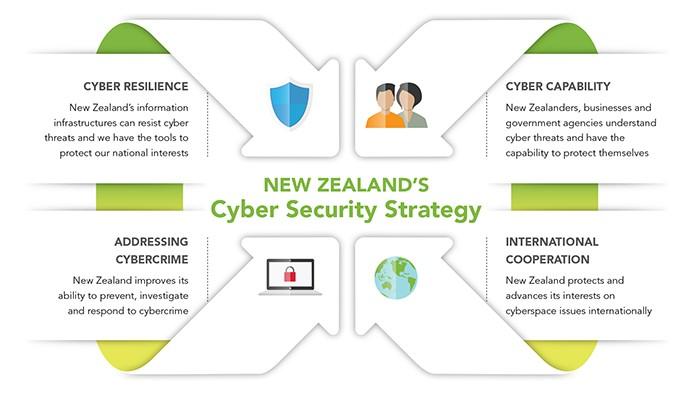
New Zealand’s Cyber Security Strategy 2019
Building a Confident and Secure Digital New Zealand
Cyber security is an important part of protecting New Zealand’s people, businesses, organisations and critical systems.
New Zealand’s Cyber Security Strategy 2019 established a national framework for responding to cyber threats and improving the country’s ability to operate safely in the digital world.
The strategy was published by the Department of the Prime Minister and Cabinet on 2 July 2019.
The 2019 strategy has since been superseded by a newer national cyber security strategy. However, the 2019 strategy remains relevant because it demonstrates New Zealand’s approach to cyber security during that period.
What was the purpose of the strategy?
The strategy’s vision was for New Zealand to be confident and secure in the digital world.
Digital technology provides significant benefits to individuals, businesses and communities, but it also creates risks.
Cyber attacks can affect:
Personal information
Businesses
Government services
Financial systems
Critical infrastructure
Digital services
The strategy recognised that cyber security is not solely the responsibility of the government.
Individuals, businesses, communities and government organisations all have roles to play in keeping New Zealand secure.
The Five Priorities
The Cyber Security Strategy 2019 identified five key priorities.
Priority 1 — Cyber security aware and active citizens
New Zealanders need to understand cyber security risks and know how to protect themselves online.
This includes developing awareness of issues such as:
Phishing
Online scams
Password security
Malware
Social engineering
Protection of personal information
Safe use of online services
Education and awareness can reduce the likelihood of individuals becoming victims of cyber attacks.
For example, understanding how to identify a phishing email can prevent someone from accidentally providing their password or financial information to a cybercriminal.
Priority 2 — A strong and capable cyber security workforce and ecosystem
New Zealand needs skilled cyber security professionals and organisations capable of responding effectively to cyber threats.
The strategy recognised the importance of developing:
Cyber security skills
Technical capabilities
Professional expertise
Industry collaboration
Information sharing
Organisational resilience
For IT professionals, this means keeping knowledge and skills up to date as technologies and cyber threats continue to change.
Cyber security professionals need to understand emerging threats and technologies rather than relying only on security practices that were effective in the past.
Priority 3 — Internationally active
Cyber threats do not stop at national borders.
New Zealand therefore needs to work with international partners to:
Share cyber security information
Respond to international threats
Investigate cybercrime
Improve international cooperation
Contribute to global cyber security efforts
International cooperation is particularly important because cybercriminals can operate from other countries and cyber attacks can involve infrastructure located across multiple jurisdictions.
A cyber attack against a New Zealand organisation may therefore involve systems, attackers or services located overseas.
Priority 4 — Resilient and responsive New Zealand
Organisations need to be able to prevent, withstand and recover from cyber incidents.
Cyber resilience includes:
Preparing for cyber attacks
Protecting systems and information
Detecting unusual activity
Responding to incidents
Recovering systems and services
Learning from previous incidents
Organisations should therefore have appropriate security controls and incident response processes rather than assuming that an attack will never happen.
Examples of measures that can improve cyber resilience include:
Secure backups
Incident response plans
Security monitoring
Access controls
Multi-factor authentication
Regular security testing
Staff cyber security training
Priority 5 — Proactively tackle cybercrime
Cybercrime needs to be actively addressed through cooperation between relevant organisations and agencies.
This includes improving the ability to:
Prevent cybercrime
Detect cybercrime
Investigate cybercrime
Respond to cyber-enabled crime
Share information about threats
Support victims of cybercrime
Cybercrime can affect individuals, businesses, government organisations and critical infrastructure.
How does the strategy guide organisations?
The strategy provides a national direction that organisations can use when considering their own cyber security practices.
An organisation should consider:
What information and systems need protection?
What cyber threats could affect the organisation?
Who is responsible for security?
How will incidents be detected?
What happens if an attack occurs?
How will the organisation recover?
How will employees be educated?
How will suppliers and third-party services be managed?
Cyber security should be treated as an ongoing process rather than a one-time task.
Practical security measures can include:
Strong authentication
Multi-factor authentication
Regular software updates
Secure backups
Access controls
Encryption
Staff cyber security training
Security monitoring
Incident response plans
Regular security testing
Cyber security and IT professionals
IT professionals have an important role in turning cyber security principles into practical systems.
When developing software or managing infrastructure, professionals should consider security throughout the system’s lifecycle.
For example, a developer should not simply build a system and add security afterwards.
Security should be considered during:
Planning
Development
Testing
Deployment
Operation
Ongoing maintenance
Considering security throughout the lifecycle can reduce vulnerabilities and help protect users, systems and organisations.
IT professionals should also consider how their technical decisions could affect the confidentiality, integrity and availability of information.
Māori perspectives on digital safety
Cyber security also needs to consider the interests of Māori communities.
Māori Data Sovereignty recognises that Māori have rights and interests in Māori data and that data governance should support Māori wellbeing, language and culture.
Māori Data Sovereignty principles
The principles of Māori Data Sovereignty include:
Rangatiratanga — Authority and control
Rangatiratanga relates to Māori authority and control over Māori data and data ecosystems.
Whakapapa — Relationships and context
Whakapapa recognises the relationships, origins and context associated with data.
Whanaungatanga — Obligations
Whanaungatanga recognises the obligations and relationships between individuals, communities and data.
Kotahitanga — Collective benefit
Kotahitanga focuses on ensuring that data can provide benefits to Māori individuals and communities.
Manaakitanga — Respect and reciprocity
Manaakitanga emphasises respect, dignity and reciprocity when collecting and using data.
Kaitiakitanga — Guardianship
Kaitiakitanga relates to protecting and responsibly managing Māori data.
Why are Māori perspectives important to cyber security?
Protecting data is not only about preventing hackers from accessing a database.
It can also involve considering:
Who controls the information?
Where is the information stored?
Who has access to it?
How is the information interpreted?
How is the information being used?
Who benefits from the information?
Could the use of the information cause harm?
Are Māori communities involved in decisions about their data?
For example, an organisation could have strong passwords, encryption and firewalls while still failing to consider whether the organisation has appropriate authority to collect or use particular Māori data.
A stronger approach to cyber security can therefore combine technical protection with cultural awareness, appropriate data governance and community engagement.
Why does cyber security matter?
Cyber security affects everyone who uses digital technology.
A successful cyber attack can result in:
Financial loss
Identity theft
Loss of personal information
Business disruption
Reputational damage
Loss of public trust
Disruption to important services
Cyber attacks can also have wider effects when they target organisations that provide essential services or operate critical infrastructure.
Strong cyber security helps organisations protect their users, maintain reliable services and maintain confidence in digital technology.
Cyber security as a shared responsibility
The Cyber Security Strategy 2019 demonstrates that cyber security is not the responsibility of IT departments alone.
Different groups have different responsibilities.
Individuals
Individuals can help protect themselves by:
Using strong and unique passwords
Enabling multi-factor authentication
Recognising phishing attempts
Keeping software updated
Protecting personal information
Reporting suspicious activity
Businesses and organisations
Organisations can help protect their systems by:
Implementing security controls
Training employees
Protecting sensitive information
Monitoring systems
Preparing incident response plans
Maintaining secure backups
Managing third-party risks
Government
Government organisations have responsibilities for:
National cyber security
Supporting cyber security capability
Responding to significant threats
Working with international partners
Tackling cybercrime
Supporting organisations and communities
Effective cyber security therefore depends on cooperation between individuals, organisations, industry and government.
Summary
New Zealand’s Cyber Security Strategy 2019 established a national approach to improving cyber security and creating a confident and secure digital environment.
Its five priorities focus on:
Cyber security aware and active citizens
A strong and capable cyber security workforce and ecosystem
International cooperation
Resilience and responsiveness
Proactively tackling cybercrime
For IT professionals, the strategy demonstrates that cyber security is both a technical and organisational responsibility.
Security needs to be considered throughout the technology lifecycle, from planning and development through to deployment, maintenance and incident response.
Ethical cyber security also requires consideration of the people and communities affected by digital systems.
In Aotearoa New Zealand, this includes Māori perspectives on data, authority, protection, cultural values and collective wellbeing.
References
Department of the Prime Minister and Cabinet. (2019, July 2). New Zealand’s Cyber Security Strategy 2019.
Te Mana Raraunga. (2018). Principles of Māori Data Sovereignty.